Diners study your flowers longer than almost anyone. A hotel guest passes a lobby arrangement in a few seconds. A table of four sits beside your centrepiece for two hours, close enough to touch it, photograph it and wonder whether it's real. That's why choosing artificial flowers for a restaurant is a skill of its own, and why I treat every dining room I design for as my toughest audience.
I've created faux florals for restaurants from Venezia in Nottingham to The Indian Tavern at Merry Hill, and the same questions come up every time. Here's how I'd choose the best artificial flowers for your restaurant, zone by zone, and the mistakes I'd help you avoid.
Start with your restaurant, then choose the flowers
The best restaurant florals feel as if they belong to the menu. Before I think about a single stem, I look at the room: the colours, the lighting, the materials, the music, even the plates. A trattoria with warm wood and candlelight suits generous, relaxed arrangements in soft whites and greens. A modern Indian restaurant can carry deep jewel colours and bold tropicals. A sleek cocktail bar wants sculptural orchids and dark vessels with a little drama.
Three questions help you choose before you look at a single arrangement:
- What should guests feel as they walk in? Celebration, calm, romance and energy each call for a different palette and shape.
- Which colours already lead the room? Pick up one accent from your upholstery, artwork or branding and the flowers will look designed for the space.
- How does the room change through the day? A bright lunchtime room and a candlelit evening room show flowers very differently, so judge them in both.
When I designed the faux flowers for Cielo Italian in Birmingham, we started exactly here. My proofs of concept matched the restaurant's style first. Only then did we settle the collection: smaller arrangements for the tables and larger pieces for the entrance and public spaces.
Think in zones
A restaurant has several places that need flowers, and each one does a different job.
The entrance
This is your first impression and often the most photographed spot in the building. A statement piece earns its keep here: a tall arrangement on the host stand, a pair of trees framing the door, or florals around the doorway itself. Scale it to be seen from the street. I've shared more ideas in how to decorate restaurant entrances with artificial flowers.
The tables
The hardest test in the room, so table flowers have their own section below.
The bar
Bars are seen at arm's length and touched constantly. One generous piece at the end of the bar gives it real presence, such as real-touch orchids cascading from a silver champagne cooler in The Mayfair. Keep it clear of the spot where drinks are served and collected.
Private dining and corners
Plants and trees soften awkward corners, screen service doors and give a private dining room its own character. A tall palm or ficus can do the work of a partition, and it brings height to a room full of tables.
The washrooms
Guests notice when the care carries on into the washrooms. A small real-touch orchid on the vanity is an easy win, and faux flowers are happy in a warm, humid room.
Walls and ceilings
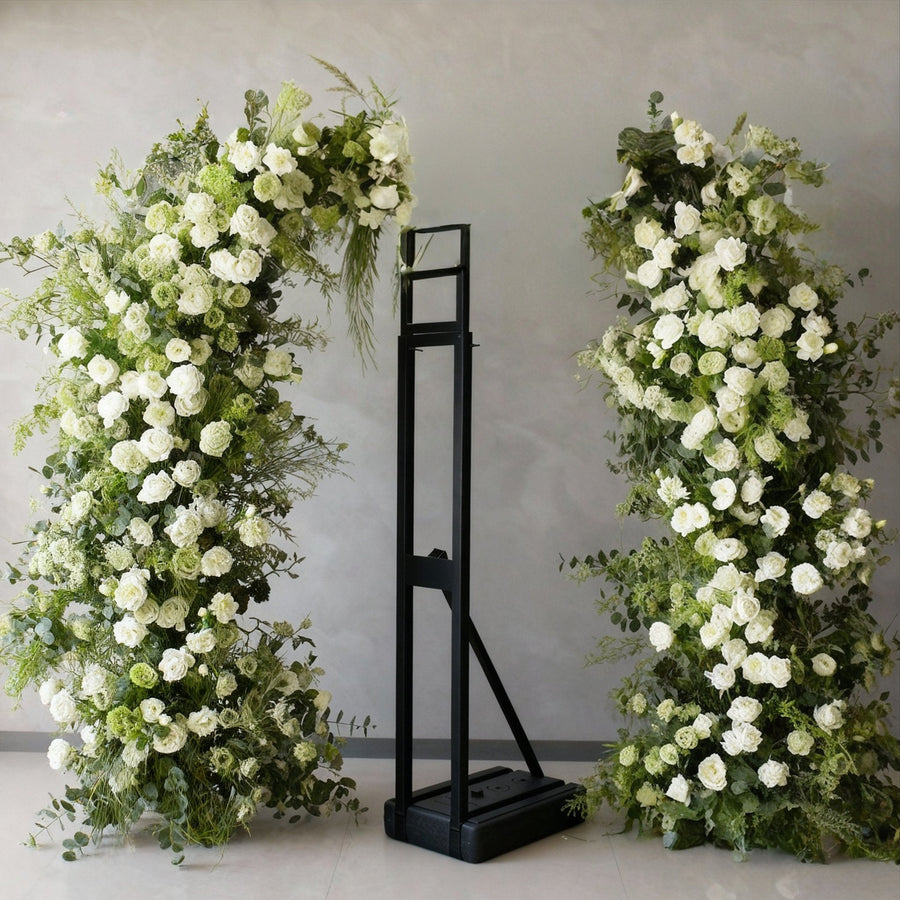
For a restaurant people remember and share online, a flower wall or ceiling installation turns a dining room into a destination. Have a look at artificial green walls for restaurants and my faux floral and botanical installations.
The terrace
Outdoor dining needs UV-resistant foliage and weighted planters, like this pair of UV-resistant cypress ball trees for a terrace entrance. My guide to artificial flowers for outdoor dining goes into more detail.

How to choose table flowers
Table arrangements sit inches from your guests for the whole meal, so they face the closest inspection in the building. These are the rules I design to:
- Keep them low. Guests should be able to talk and catch each other's eye across the table with nothing in the way. Low, compact pieces work best on most tables.
- Mind the footprint. Plates, glasses, sharing dishes, bread and the card machine all need room. A small base takes up very little of the table.
- Choose real-touch stems. Diners will reach out and touch them. Real-touch petals feel soft and natural and pass that test with ease.
- Weight the vessel. A heavy base stays put when plates are cleared or a sleeve brushes past.
- Make them easy to wipe. Choose vessels and finishes your team can clean in seconds at the end of service.
- Give candles space. Keep every arrangement a safe distance from naked flames.
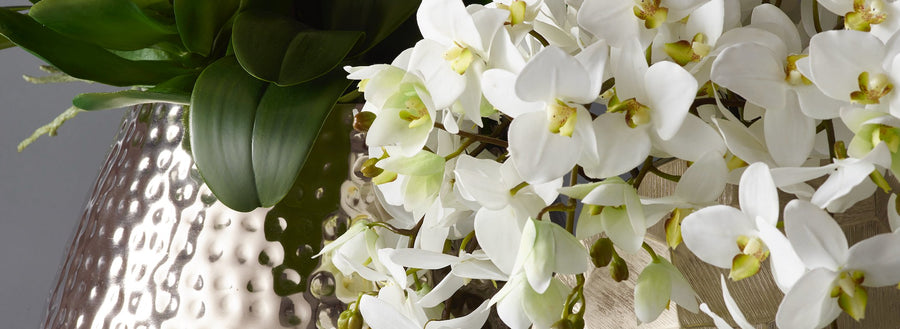
Orchids are the classic choice for tables because they're the most convincing faux flower of all. Sculptural textures work beautifully too, like the deep green Trick Dianthus in a 20cm anthracite bowl. For a restaurant I usually design a matching set of table pieces in your colours and to your table size, with taller orchids such as The Holland kept for the host stand, sideboards and window ledges.
Choose flowers that pass the close-up test
In a restaurant, quality shows. Under bright daylight from a window, or a spotlight over the pass, cheaper stems give themselves away with shiny petals, flat colour and moulding lines. These flowers translate into real-touch materials almost perfectly:
- Orchids. Smooth, waxy petals that fool almost everyone. See my real-touch orchids.
- Calla lilies. One sculptural petal and a clean stem, as in The Calla.
- Tropicals. Bird of paradise, gloriosa and anthurium have bold shapes and firm petals that suit lively dining rooms. The Tropicana brings that colour to a bar or entrance.
- Hydrangea and roses. Lovely in fuller arrangements for a softer, more romantic room.
- Foliage and trees. Palms, ficus and olive add height and life to a dining room without taking up table space.
For a fuller guide to judging quality, read just how realistic premium artificial flowers look, or see my flowers up close, petal by petal.
Practical points every restaurant should check
- Fire safety. Restaurants are public spaces, so ask whether your fire risk assessment calls for fire-retardant florals. I supply fire-retardant artificial plants and trees, such as this fire-rated ficus and fire-rated areca palm. My guide to fire-retardant artificial plants explains more.
- Scent and pollen. Faux flowers have no scent and no pollen, so nothing competes with the aromas from your kitchen and no petals drop onto plates.
- Cleaning. A gentle dust every couple of weeks keeps everything looking freshly delivered. Pieces near an open kitchen may need a little more care, so place them with that in mind.
- Sunlight. Strong direct sun fades any colour over time. Window tables and terraces deserve UV-resistant pieces.
- Security. Smaller table pieces can walk. Weighted or fixed vessels help keep them where they belong.
Buy, hire or refresh?
Fresh flowers come with a weekly bill. Faux florals are one investment that lasts for years, and you can choose how to make it.
- Buy. Best for signature pieces that define your restaurant all year round.
- Hire. Ideal for launches, events and private parties. See my artificial flower rental and hire.
- Refresh. My seasonal refresh service changes your scheme through the year, from spring blossom to Christmas installations, so regulars always find something new.
Mistakes I see most often
- Too small. A modest arrangement disappears in a big dining room. One confident piece does more than several timid ones.
- Too tall on the table. If guests have to move it to talk, it's in the wrong place.
- Matched to nothing. Flowers chosen in isolation look bought in. Florals tied to your colours look designed.
- Cheap stems in prime spots. Save money in the far corners if you need to. Put your best stems where guests sit closest.
- Forgotten after opening. A dusty arrangement undoes all the good work, so build a quick dust into your cleaning rota.
How I design for restaurants
Every restaurant I work with starts with a conversation. I visit your space, look at how it's used from the first booking to the last, and share ideas and colour direction before anything is made. Every piece is then designed in my studio to the proportions your room needs, and installed around your opening hours, ready for service. In the capital, I also design florals for London restaurant frontages and dining rooms, where a doorway or window has to catch the eye of a busy street.
You can see more of this work on my faux flowers for restaurants page, along with St Martin's House in Covent Garden and the rest of my projects.
If you're planning florals for your restaurant, I'd love to hear about it. Plan your restaurant florals and I'll come back to you personally with ideas and a clear quote. For hotels, bars, offices and venues, read more about faux flowers for business.
Sharon Demmery
Founder & designer, Demmerys Faux Floral Studio